
Amite County Deed Record Types
Amite County deed records gather the instruments the Chancery Clerk accepts for recording. Some convey ownership outright. Others secure a debt, release a claim, or give notice of pending litigation. The index label is a hint, not the law. So read the actual deed before drawing a legal conclusion.
| Deed Type | What It Does | Common Use |
|---|---|---|
| Warranty deed | Conveys the stated interest with covenants | Ordinary purchase transfer |
| Quitclaim deed | Conveys whatever interest the signer has | Family transfer or title cleanup |
| Executor deed | Conveys under estate authority | Probate-related transfer |
| Trustee deed | Conveys through a trustee's authority | Trust or foreclosure context |
| Tax deed | Records a transfer after the statutory tax process | Tax-sale property after required steps |
A deed transfers an ownership interest in Amite County land. A deed of trust does something different. It secures a debt. A lien only gives notice of a claim against the property. Start with General Index-Deeds for the conveyance. Then check the separate deed-of-trust, substitution, lien, lis pendens, and judgment indexes for anything burdening the same parcel.
Amite's Land Index Families
The county's own directory sorts Amite County land records into distinct index families: Original Entries-Patents, General Index-Deeds, General Index-Deeds of Trust, General Index-Substitutions, Sectional Index, Map/Plat Book, Lis Pendens Record, Construction Liens, Federal Tax Liens, Federal Civil Judgments, Chancery Index/Docket, Will Book, and Oil and Gas Records. Each index does one job. Use the deed index to locate conveyances, and a deed-of-trust search turns up the security instruments behind a loan. A substitution can name a successor trustee. Lis pendens flags litigation that may affect the land. The sectional index supports rural tract research, while the plat book covers subdivision lots and blocks. Mineral and royalty interests may need their own trail.
Why Amite Deeds Are Offline
Amite County keeps its deeds offline. The county FAQ states plainly that deed records are not online. No public grantor-grantee web form or image portal exists. Inspection happens at the Chancery Clerk's office, 243 W Main Street in Liberty. Hours are Monday through Friday from 8:00 a.m. to 5:00 p.m. New documents are recorded when received. They are open for public viewing by the next day.
Use the web only to collect clues. The TSC appraisal search can supply PPIN, PARID, the current roll owner, and legal text. It can also supply DEED BK and DEED PG. Take those numbers to the counter. The recorder's office controls the recorded instrument, not the appraisal result.
Counter shortcut. Bring the deed book and page plus a legal-description fragment; an address alone is often not enough for rural land.
Walk Amite's Deed Chain Backward
Start with the latest purchase deed. It shows the present owner as grantee, the party receiving the interest, and the grantor who transferred it. Note any prior book and page the document cites. Then search that grantor as a grantee in the earlier period to keep the chain moving.
- Use the TSC owner and deed reference to find the newest conveyance.
- Confirm the parcel through its legal description, not merely a similar surname.
- Record the grantor, grantee, recording date, and book/page from the instrument.
- Search the grantor as an earlier grantee, then repeat until the needed date.
- Use sectional, plat, probate, and archive records when the name chain breaks.
Record the role, not just the name. Roles flip as you move backward. The grantor in one deed often appears as the grantee in the next earlier link, so join entries carefully. Estates, trusts, and companies complicate the sequence. Search the decedent, the executor or administrator, the trustee, and exact business names when those roles appear. Match legal descriptions before treating same-name entries as one chain.
Dates describe different events. Execution, acknowledgment, recording, and the assessor's January 1 ownership snapshot need not coincide. Chancery makes a received deed viewable by the next day, while the appraisal roll follows its annual schedule. Log each date with its source. Never assume the TSC roll owner and the newest deed grantee match.
- Grantor
- The party transferring the stated interest.
- Grantee
- The party receiving the stated interest.
- Chain of title
- The ordered sequence of transfers tied to one tract.
- Book/page
- The volume and page reference used to retrieve an Amite instrument.
Court transfers break the index trail. Go beyond the deed books. The Chancery Index/Docket and Will Book can reveal an estate, partition, or title order, and Amite Chancery MEC begins with its August 15, 2016 go-live. Remote PAMEC access may surface an eligible electronic case. Older papers often stay at the clerk's office. Read the operative order, then look for any deed recorded from it. A docket entry explains the proceeding. The recorded land instrument completes the courthouse trail.
Older volumes raise their own questions. Ask whether the book sits in the active vault, appears on county microfilm, or is held in the MDAH collection. The abstract runs begin in 1823. They carry no index, so name queries give way to manual browsing by volume and date; preserve every book, page, tract description, and prior reference.
Get an Amite Deed Copy
Work from the indexed deed at the Chancery office first. Then pick the copy that suits your task. You can make your own copies at 25 cents per page. Staff-made copies run 50 cents per page. Certification adds $1 per document. Ask ahead whether the volume can be self-copied. Confirm whether staff must produce a certified version.
Written requests go to Amite County Chancery Clerk, P.O. Box 680, Liberty, MS 39645. List the owner names, the PPIN or PARID, the legal description, and book and page. Include the year range. State the copy type you want and your return contact. Confirm payment instructions in advance; the clerk's main number is 601-657-8022.
Recorded, not guaranteed. The Amite deed index shows what was filed. Unrecorded interests may exist, and only a qualified professional can give a title opinion.
Search Beyond the Amite Deed
A deed is only one piece of the land file. Deeds of Trust carry the recorded security interests, so ask for those too. Substitutions and assignments show later changes to a loan or its servicer. Construction liens, federal tax liens, lis pendens, and federal civil judgments each sit in their own named index families. A deed search alone will not surface them.
| Deed of trust | Secures an obligation against land. |
|---|---|
| Substitution | May identify a successor trustee. |
| Lis pendens | Notice that pending litigation may affect property. |
| Release or satisfaction | Records that an earlier claim has been cleared. |
| Plat | Relates lots and blocks within a recorded division. |
Legal effect flows from the instrument itself and the law that governs it. An index label never proves a claim still stands today.
Amite Abstracts Begin in 1823
The MDAH county microfilm catalog lists Amite abstract-book runs for 1823-1901, 1834-1883, and 1839-1884. Those catalog rows note that the abstracts carry no index. A historic deed-record search can mean paging through a volume and date range rather than typing in a name. That catalog entry is the archive route for older Amite County deed records.
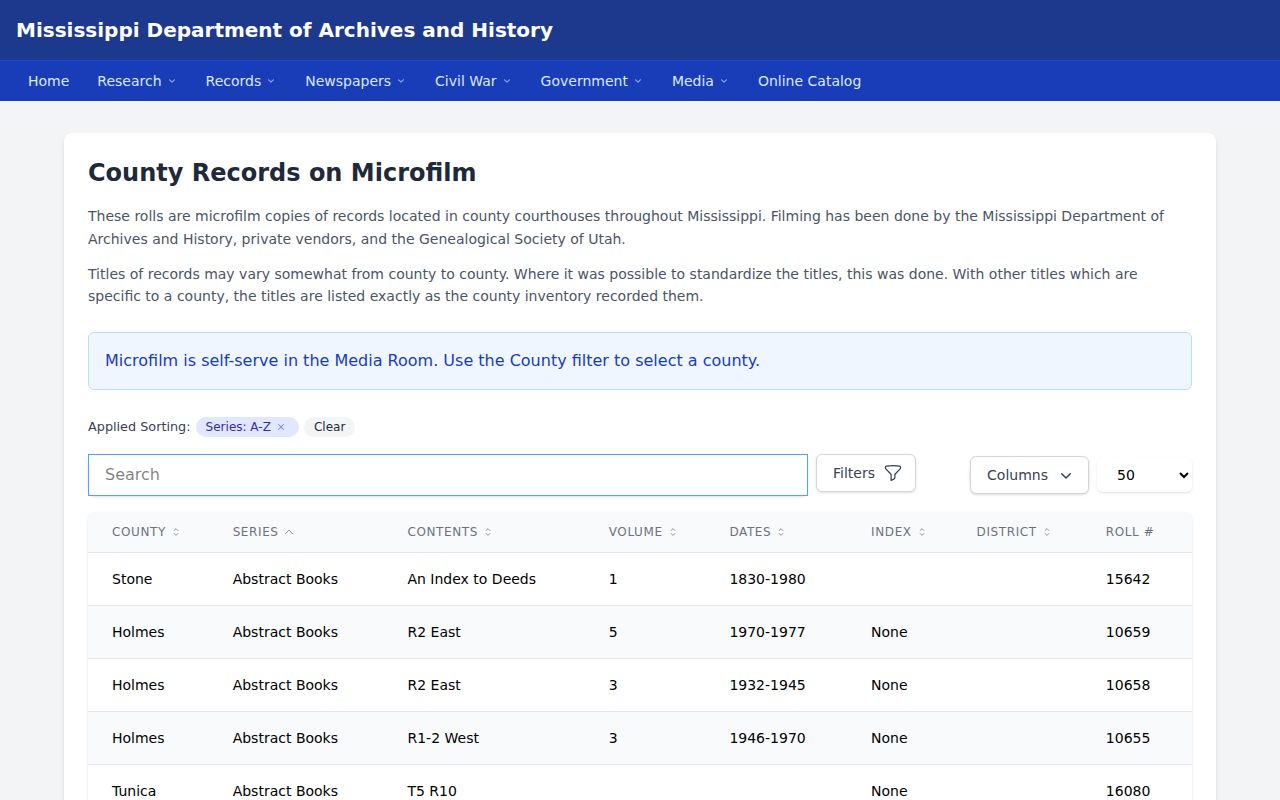
Microfilm is self-service in the MDAH Media Room. Original record boxes require an Archival Reading Room request. Before you travel, ask Chancery whether the book you need sits in the active vault, exists on county microfilm, or waits at MDAH.
Gloster Deeds Use Town Blocks
An older Gloster deed may not mention a modern street number at all. One documented example instead refers to the plat of the Town of Gloster, Block 19, Section 34, Township 3 North, Range 2 East. Trace that lot and block through the Map/Plat Book. Then match the same legal language in later deeds.
Rural Amite parcels often follow a different pattern. Descriptions may rely on section-township-range calls, metes and bounds, roads, creeks, or adjoining owners. Whatever form it takes, the legal description is the text that identifies the land conveyed. Keep it beside the owner-of-record chain. Two people sharing a name can hold different tracts. Only the description sorts them apart.
Probate Can Break a Deed Chain
Not every transfer starts with a plain sale. An estate file, will, court decree, partition, or executor deed can explain a change. A simple buyer-seller sequence may hide that change. The Chancery Clerk also serves as clerk for estates and land-title disputes. That makes the Chancery Index/Docket and the Will Book natural companion sources for a deed search.
Amite Chancery MEC went live on August 15, 2016. Remote PAMEC access can flag eligible electronic cases. But older papers and the controlling deed stay with the clerk. Courthouse viewing is free during regular hours. Registered attorney and non-attorney PAMEC users pay a published $10 annual account fee.
Recent Amite Court Indexing
Amite Circuit Court joined MEC on March 10, 2025. Circuit records matter when a judgment or execution touches real property. The Sixth Circuit information page documents that transition.
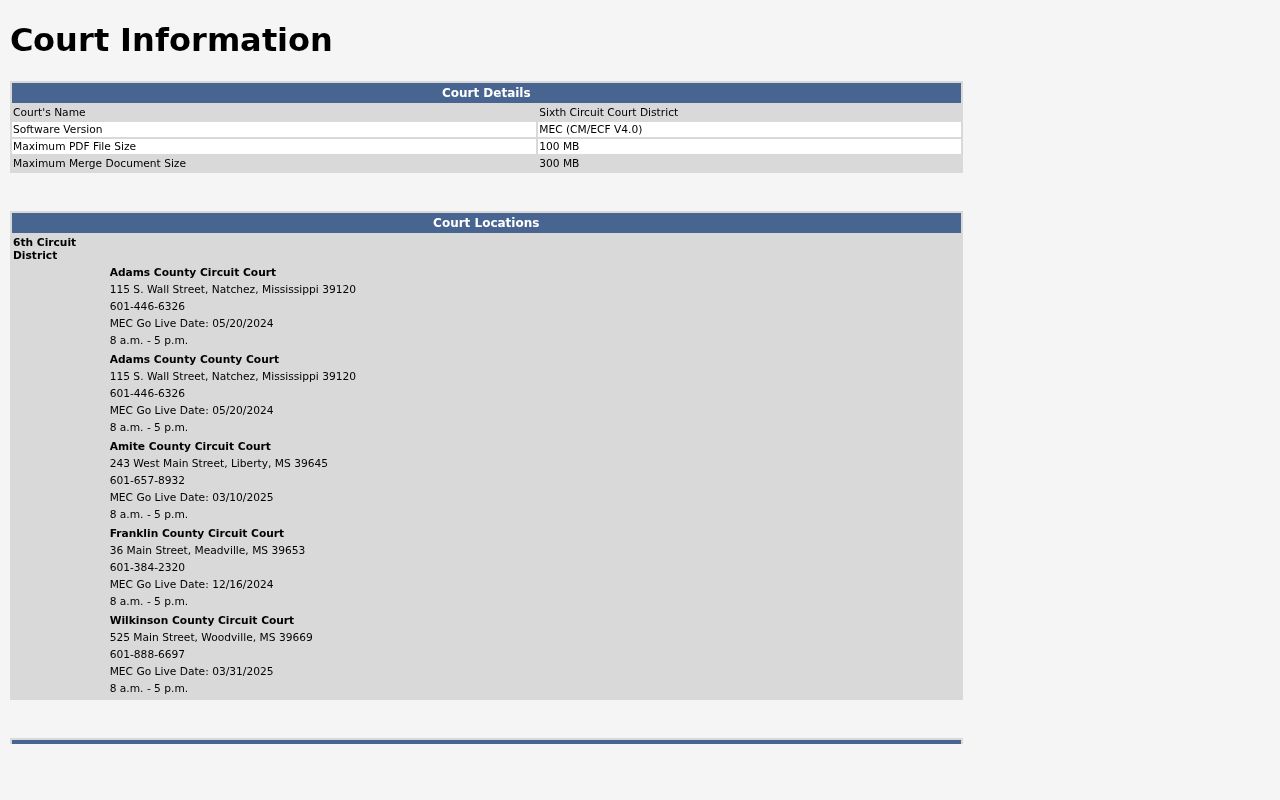
That date promises nothing about older records. For pre-electronic filings, contact the Circuit Clerk at 243 W Main Street, 601-657-8932.
Tax Deeds Need Redemption Proof
Amite land taxes come due February 1. The county holds its land sale on the first Monday in April. Mississippi law gives owners a two-year redemption period for real property sold in that process. A tax-sale list alone proves nothing about redemption. Nor does it prove a mature tax deed transferred title.
Start with the Tax Assessor/Collector to confirm the sale date and collection status. Then check Chancery for redemption evidence and any recorded tax deed. Follow with later conveyances, liens, and court files as needed. A commercial pre-sale list is no substitute for that official sequence.
Amite Deed Fraud Checks
Amite County offers no official property-alert signup. Mississippi Senate Bill 2751, introduced in 2026, proposed a deed-fraud prevention framework and clerk alert systems, but introduction alone proves neither enactment nor local adoption.
When a deed looks suspicious, compare the owner, legal description, recording date, signatures, and notary details against the Chancery copy. Contact the clerk and the appropriate law enforcement. Seek legal help if forgery seems likely. Steer clear of high-priced deed-copy solicitations dressed up like government invoices; the county's own copy prices are published and far lower.