
Find Out Who Owns an Amite County Property
Amite County splits its property records between two places. The county keeps no deeds online. TSC Maps still provides online appraisal discovery, though. Finding an owner becomes a handoff: run the address or name search on the web, then finish at the Chancery Clerk's counter in Liberty. Preserve each identifier as you move, because a shared name or a changed road address can push the search onto another tract.
- Enter the property address in the Amite TSC appraisal search; retry with owner, PPIN, or PARID if it fails.
- Copy OWNER, PPIN, PARID, DEED BK, DEED PG, and LEGAL 1 from the matching result.
- Take the deed reference to the Chancery Clerk and confirm the newest grantee and legal description.
- If the grantee is an LLC, trust, or estate, check the official entity or probate record for context.
Four TSC Fields Point Toward the Amite County Owner
The Amite TSC appraisal search exposes four fields: PPIN, PARID, Owner, and Address. The parcel keys matter most. A person's name can be misspelled, abbreviated, or shared, while PPIN and PARID follow the property record itself. Search by address first, then copy both identifiers.
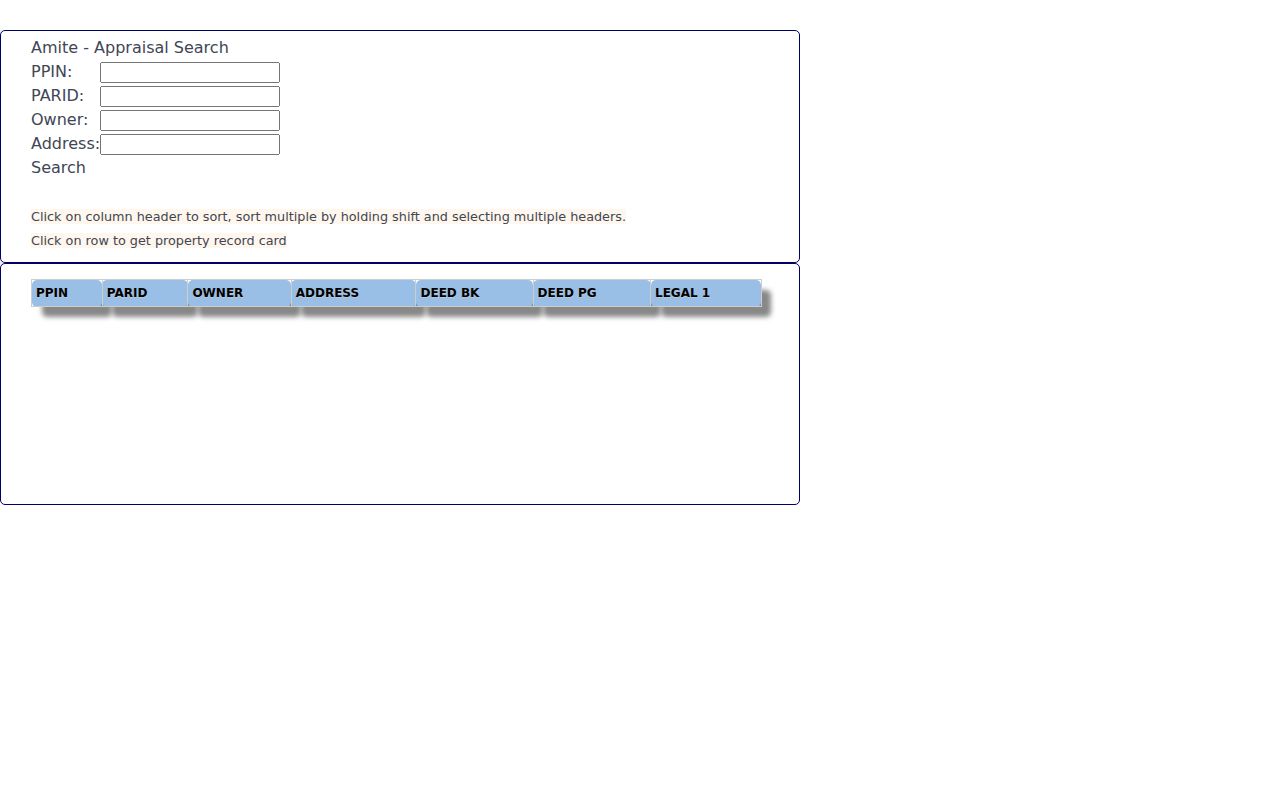
A typical result screen shows OWNER, ADDRESS, PARID, PPIN, DEED BK, DEED PG, and LEGAL 1. Those deed columns are the local advantage. They point from the free web result straight toward the offline recorded instrument at the clerk's office. The appraisal result is not a certified deed.
Why an Amite County Address May Miss the Owner
Three identifiers mean different things. A mailing address receives the notices. A situs address, by contrast, describes the physical place on the ground. The legal description does the legal work. In rural Amite County it may rest on section, township, and range, or on a road, creek, or community name that outlasts any modern street label. Gloster lots can add town plat, block, and lot language.
No direct match? Try the exact owner spelling, a prior owner, or the parcel number. Amite County's 911 application asks for the road entrance, directions, parcel or PPIN, and an owner or previous owner for a recent purchase. The form shows why addresses and deed descriptions can differ.
Which Amite County Sources Identify the Property Owner?
Each public source answers a narrower question. The tax roll discovers a name. The deed names the recorded grantee. A plat map keeps the search attached to the correct land, while an entity filing can explain a business name without replacing the conveyance itself.
| Source | Owner Info It Gives | Access |
|---|---|---|
| Assessor roll | Annual OWNER name, mailing or situs clues, PPIN and PARID | Free TSC web search or assessor office |
| Chancery land index | Grantee and instrument that conveyed the tract | Public inspection at the Liberty office |
| Secretary of State | Business identity, officers, and registered agent | Official online entity search |
| County GIS | Parcel position and map context linked to county data | Free public viewer |
The person living in a house may be a relative, a guest, a manager, or another lawful resident. None of that changes the owner of record. A registered agent works the same way. The agent serves as an LLC's public contact, not proof that the agent owns the parcel personally.
- Owner of record
- The party named on a particular official roll or recorded instrument.
- Grantee
- The person or entity receiving the interest stated in a deed.
- Vesting
- The deed language that identifies how the grantee takes title.
- Situs and mailing address
- The land's physical location and the separate destination for notices.
The Amite County Deed Book and Page Finish the Route
The Chancery Clerk in Liberty records Amite County deeds. Deeds of trust, construction and condominium liens, federal tax liens, lis pendens, and plats all pass through the same office. It is the same land-record office for every one of them. The counter sits at 243 W Main Street, with mail to P.O. Box 680 and phone 601-657-8022. Public inspection runs Monday through Friday.
No deeds are online. Bring the clerk an owner name, PPIN or PARID, deed book and page, or an abbreviated legal description. Any one of those will do. Compare the newest deed's grantee with the TSC OWNER field. A deed recorded after January 1 may be newer than the annual assessment roll. The county publishes no fixed update lag.
Estates Can Complicate Who Owns Amite County Land
A death does not rewrite every public screen at once. Amite Chancery Court holds the estate, guardianship, conservatorship, and related land files. Several papers can bridge the gap. A will, a decree of distribution, an executor's deed, an administrator's deed, or heirship evidence may trace the path from a deceased owner to the current grantee. Use probate as context for the transfer, then return to the recorded instrument.
Mississippi vital records have eligibility limits. They are not open inspection records. A family-history clue or an obituary can help separate similar names, but neither establishes fee ownership; the deed and the court order carry the legal transfer evidence.
LLCs and Trusts Answer “Who Owns?” Differently
When the tax roll names a company, try the Mississippi Secretary of State search. The search covers name, ID, officer, and registered agent. Use the exact deed spelling first, endings included. The business record names the legal entity and its public service contact. It cannot prove personal ownership.
Trusts need the same restraint. Read the grantee and trustee language on the recorded deed. Consult an estate or trust file only when it is lawfully available and relevant, and never swap a named trust for a beneficiary's name unless an official record supports that conclusion.
Check Encumbrances After Identifying an Amite County Owner
A name on a parcel is only the first answer. The title may still carry weight you cannot see. Deeds of Trust, construction liens, federal tax liens, lis pendens, releases, and judgments all sit in separate indexes. They are worth checking once an Amite County owner is identified. Run both current and former indexed names too. A filing that overlaps a conveyance can change what the record means.
Amite County itself tells searchers to compare Chancery, Circuit, and Tax Assessor records. It also says to bring in an attorney for a real title search. Finding an owner of record is a due diligence starting point, never a title opinion. The deed records guide covers the instrument side in more depth.
Amite County Access Continues Beyond the Web
The web form is one channel among several. The Tax Assessor/Collector sits at 243 West Main Street in Liberty, takes mail at P.O. Box 356, and answers at 601-657-8973. The Chancery Clerk shares the same courthouse address, receives mail at P.O. Box 680, and can be reached at 601-657-8022. Land records are open for inspection on weekdays. County sources quote slightly different office-hour windows, so call ahead before a late-day visit.
For a mailed or counter request, supply the address, the PPIN, the PARID, the exact indexed name, the deed book and page, the legal description, the document type, and an approximate date. Copy fees come in three tiers. A public-made copy runs $0.25 per page. Staff-made copies cost $0.50 per page, and certification adds $1. Those numbers make it easy to tell an official copy route from a pricey deed solicitation.
Older ownership questions can move to the Mississippi Department of Archives and History. Its Amite abstract-book microfilm runs back to 1823. The catalog notes those abstracts carry no index. Expect manual book work rather than a modern name box. Original boxes require an Archival Reading Room request. Microfilm is self-serve in the Media Room. Those historic channels only matter once the parcel is firmly identified first. Start with Amite County property records and go from there.
No Verified Amite County Deed Alert Is Available Yet
Senate Bill 2751 was introduced for 2026. It proposed a Mississippi deed-fraud prevention framework with chancery property alerts. The measure is a proposal, not law. No Amite County signup page exists. Treat any claim of active notifications protecting your parcel with suspicion.
A suspicious deed deserves a close look at Chancery. Compare the legal description, recording date, parties, signatures, and notary details. Report suspected forgery to the clerk, law enforcement, and counsel. A paid solicitation or third-party notice proves nothing about ownership.
Limits of “Who Owns This Property?” in Amite County
Public property records have edges. A record can name an assessed owner or a recorded grantee. It cannot confirm who lives at the address, cure every title defect, or replace a boundary survey. Mississippi's Address Confidentiality Program, authorized by Miss. Code Ann. §99-47-1, gives eligible victims of domestic violence, sexual assault, or stalking a substitute address with mail forwarding. Never try to defeat that protection.
Lawful use. Use Amite County owner records for legitimate property research. Mississippi §§97-3-107 and 97-45-15 address stalking and harassment.