
Three Meanings of Amite County Property Value
Three numbers travel under one name. Mississippi law splits true value from assessed value, and a recorded deed can add a transaction clue, so the leading table keeps each measure from being mistaken for the others.
| Value | What It Is | Where |
|---|---|---|
| True value | The assessor's appraisal basis before classification | Annual assessment roll |
| Assessed value | True value multiplied by the statutory class ratio | Annual assessment roll |
| Last sale or consideration | A past transaction clue, when the instrument states it | Recorded deed or transfer material |
| Current market opinion | A present, property-specific estimate | Qualified private appraisal, not the tax row |
Class I owner-occupied residential real property is generally assessed at 10 percent of true value; other real property is generally Class II at 15 percent. Thus assessed value is designed to be lower than true value. It is not the last sale price.
Keep the date and source beside every number. The annual roll is a government assessment record; deed consideration, if an instrument states it, belongs to a particular transfer; and a qualified appraisal is a property-specific opinion as of its effective date. Dividing one measure by another without checking the property class, valuation year, acreage, improvements, and transfer type can create a comparison the underlying records do not support.
The combined Amite County Tax Assessor/Collector maintains the roll and ownership maps at 243 West Main Street in Liberty. Its public search is the starting point for the assessment figure, while the Chancery land record supplies the deed evidence. Neither office's record should be relabeled as a present asking price.
Amite County Uses 10 and 15 Percent Real-Property Ratios
The Mississippi Department of Revenue lays out the state's five assessment classes. Class I covers qualifying owner-occupied residential land and improvements at 10 percent. Class II covers other real property at 15 percent.
| Stage | Question answered | What changes it |
|---|---|---|
| True value | What appraisal basis did the assessor assign? | Property facts and reappraisal |
| Classification | Which statutory ratio applies? | Legal class and qualifying use |
| Assessed value | What value enters the tax calculation? | True value multiplied by ratio |
Millage operates after assessment. Bill totals and appeal steps belong in the property tax records guide, which picks up where valuation ends.
Find an Amite County Property Value by Parcel
The free Amite TSC appraisal search accepts PPIN, PARID, Owner, and Address. A parcel identifier beats a rural street label. The result grid shows PPIN, PARID, OWNER, ADDRESS, DEED BK, DEED PG, and LEGAL 1. Selecting a row opens the fuller card. Fields beyond the grid live on the card itself.
- Search by address, PPIN, PARID, or the recorded owner name.
- Match the result's address and legal clue before reading any value.
- Record the value year, true value, assessed value, and classification if shown.
- Use DEED BK and DEED PG to inspect the transaction record at Chancery.
- Assessed value
- The class-adjusted tax base.
- True or appraised value
- The assessor's full-value basis before the ratio.
- Assessment ratio
- The statutory percentage applied for the property class.
The Amite County Roll Updates Annually, Reappraisal Runs Longer
The county assessor builds the roll each year. It starts from a January 1 ownership snapshot. Updates go to the Board of Supervisors before its July meeting. Mississippi also orders a reappraisal of real property at least once every four years. These clocks run separately. A recorded deed may refresh the owner row while the appraisal cycle waits its turn.
The county publishes no fixed revaluation year. No standard update lag is posted either. A recent deed can outrun the OWNER field, and a fast market shift may not show in mass-appraisal figures right away. A jump between roll years can stem from a class change, new improvements, corrected acreage, or a reappraisal. The numbers alone never name the cause.
Save the PPIN and PARID for any comparison. Record the roll or valuation year too. Add true value, assessed value, property class, and any exemption indicator the card displays. If the full card will not load, or a label is unclear, call the assessor at 601-657-8973 or write dmoore@amitecountyms.gov and request the official roll entry. The result grid cannot show every field. Do not infer a sale history or exemption value it never displayed.
Note: Always record the valuation year, because comparing figures without their dates can make an ordinary cycle look like an unexplained error.
A Recorded Amite Sale Is a Clue, Not Today's Value
Amite deeds are not online. The TSC result's DEED BK and DEED PG columns bridge the appraisal row to the Chancery Clerk's counter at 243 West Main Street in Liberty. Inspect the instrument itself. It shows whether consideration is stated and whether the transfer was an arm's-length sale, gift, quitclaim, or estate event. A stated figure may include more than cash. Some instruments never touched the open market. Confirm the deed in person, by mail request, or by calling 601-657-8022 about the proper index and copy route. The record can support a comparison but cannot set a current asking price.
Homestead Changes Taxable Results, Not Amite True Value
A homestead exemption changes the tax bill, not the appraisal. The state homestead program accepts county applications from January 1 through April 1. Qualifying can change what is taxed. It does not rewrite the assessor's underlying true-value opinion. Mississippi also sorts property into classes before tax calculations apply. So read exemption, classification, assessment ratio, and appraisal basis as separate fields or separate decisions.
Two similar parcels can show different taxable results. Compare class and exemption status first. Confirm both records describe the same acreage and the same improvement set. Check that both use the same valuation year. A parcel split, a new structure, a corrected property characteristic, or a different qualifying use can undo a quick side-by-side comparison, even when the parcels look alike on a map.
Call with questions about a specific entry. The combined Amite County Tax Assessor/Collector can be reached at 601-657-8973 or dmoore@amitecountyms.gov. The state page explains the program framework. The county, though, receives the application and maintains the local assessment record.
Amite Tax Rolls Offer a Long View, Not a Price Index
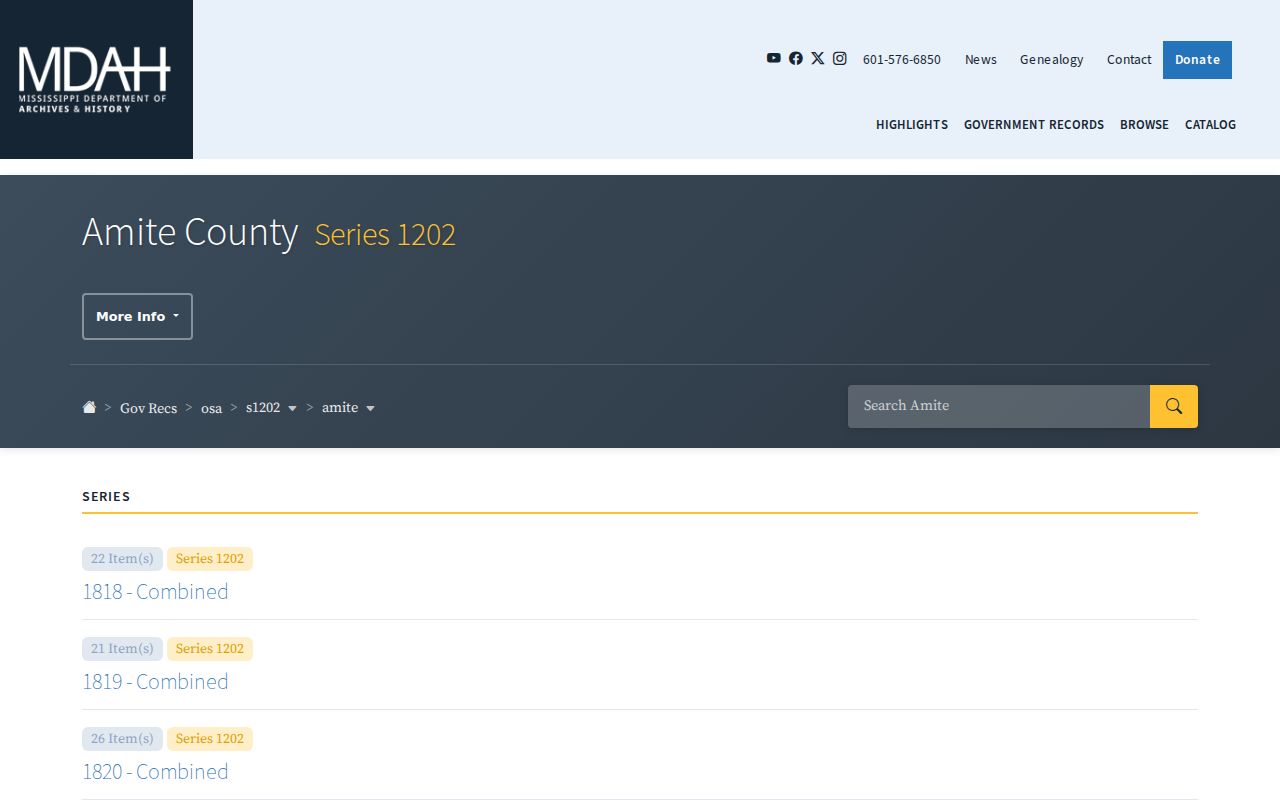
The MDAH historical Amite tax series reaches back to 1818. Its land and personal-property entries run through many nineteenth-century years. The rolls cover a given tax period. They can show whether a surname or a tract appeared there. An MDAH finding aid also covers territorial and early state records for Amite County. Identified deed-abstract microfilm begins in 1823. Together these sources explain chronology. But an old assessment will never read like a modern tax roll.
Old dollars deceive. Currency, property class, improvements, acreage, and law all changed, so a simple dollar comparison misleads. First match the taxpayer to a tract through the period's land description, neighboring names, or deed reference. Then decide whether acreage, improvements, ownership share, or parcel boundaries shifted before treating two entries as a sequence.
Request original archive boxes in the Archival Reading Room. Microfilm is self-serve in the Media Room. Copy each entry exactly, recording series title, year, page or image, taxpayer, description, and amount. Use older rolls for chronology. Deeds and plats show later changes to the tract. A historical tax figure documents an assessment inside its own system, not an inflation-adjusted sale price or a modern market estimate.
What an Amite County Assessed Value Cannot Tell You
An assessment is a mass-appraisal and tax figure. It has real limits. It does not inspect every condition issue before a sale, promise a buyer's offer, establish replacement cost, settle acreage, or account for every private easement. A value row can also lag a recent transaction or improvement.
Verify the tract before questioning a figure. Match PPIN, PARID, ADDRESS, and LEGAL 1 in the TSC result to confirm the intended parcel. Then separate fact disputes from valuation judgment. The public result is a useful locator. The combined Assessor/Collector remains the source for the official roll entry and the county-specific explanation of what the recorded figure represents.
Value is not price. An Amite County assessed value supports taxation and is not what the property will sell for. Obtain a qualified appraisal for a present market opinion.
Use the official roll as a dated public benchmark. Then compare the current physical property and relevant transactions against it, keeping the assessment evidence in its proper role.