
Build an Amite County Former-Owner Timeline
Amite County deeds are not online. There is no digital index cutoff to worry about. A practical search begins in TSC Maps. The parcel and current owner of record appear together there. The ownership trail then moves to the Chancery Clerk's General Index-Deeds. Older work continues in courthouse volumes. The Mississippi Department of Archives and History collections hold still more.
| Source | Years It Covers | Where Held | What It Shows |
|---|---|---|---|
| General Index-Deeds | Current courthouse series | Amite Chancery Clerk | Grantor, grantee, instrument and book/page |
| Abstract books | Runs beginning in 1823 | MDAH microfilm | Condensed early land entries, cataloged without an index |
| Map/Plat Book | Dates vary by recorded plat | Chancery Clerk | Town blocks, lots, subdivisions and survey context |
| Historic land-tax series | Land entries into the late 1800s | MDAH | Taxpayer and tract clues between deeds |
Turn first to Chancery when a chain is already known. MDAH earns its place when courthouse references reach an older abstract, or when tax and map context can bridge a changed name, road, or community.
Amite County Deeds Require a Counter Visit
The Amite County Chancery Clerk at 243 W Main Street in Liberty holds the deed records. Those records cover deeds, deeds of trust, plats, liens, lis pendens, and releases. Call 601-657-8022 or write P.O. Box 680. Give the parties, book and page, document type, and legal description. Public inspection runs Monday through Friday, 8:00 a.m. to 5:00 p.m. The county says an instrument received for recording is open for inspection by the next day.
Bring the current PPIN or PARID. Bring current and suspected former-owner names too. Add a fragment of the legal description and any deed book and page already exposed by TSC. Ask the staff which index should lead the search. The verified index families include General Index-Deeds, Original Entries-Patents, Sectional Index, Map/Plat Book, Will Book, and Chancery Index/Docket. There are also separate indexes for deeds of trust, substitutions, construction liens, federal tax liens, lis pendens, federal civil judgments, and oil-and-gas records. These are different trails. A deed chain should not quietly absorb a mortgage or lien entry as if it conveyed ownership.
Mail requests go to the Chancery Clerk, P.O. Box 680, Liberty, MS 39645. State the parties, parcel and legal clue, book and page or year range, document type. Say whether an ordinary or certified copy is needed. Include return contact information. Confirm payment and mailing instructions by phone first. Public-made copies cost $0.25 per page, staff-made copies $0.50 per page, and certification adds $1. These options let a researcher preserve each link in the chain without ordering unrelated files. A full title conclusion still calls for professional examination. Clerk staff do not prepare deeds or give legal advice.
The 1823 Amite Abstract Trail
The strongest dated fallback is the MDAH county microfilm inventory for Amite abstract books. Its runs span 1823-1901, 1834-1883, and 1839-1884. The catalog warns that the abstracts carry no index. So no simple name query will surface former owners. Note the book, page, parties, tract language, and next reference while browsing by hand.
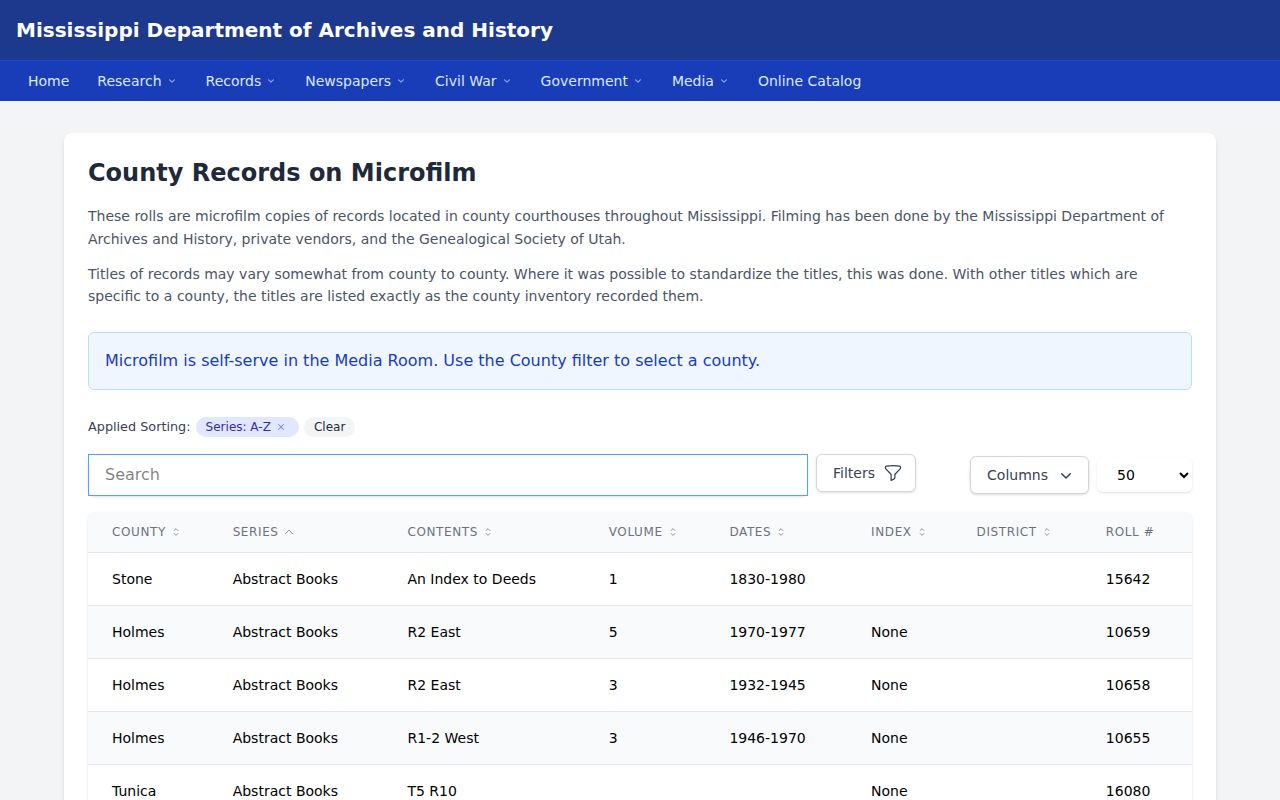
Request original archive boxes in the Archival Reading Room. Microfilm is self-serve in the Media Room. Choose the run from the inventory entry before browsing, and keep its call information with every ownership note. The broader Amite finding aid spans territorial and early state records, giving court and land-tax context when an early conveyance reads nothing like a modern deed.
Walk the Amite County Deed Chain Backward
A reverse chain starts from a parcel, never a surname alone. Copy the PPIN, PARID, LEGAL 1, and deed book and page from the TSC appraisal result. Then match the newest recorded instrument at Chancery.
- Find the present owner's acquiring deed with that owner listed as grantee.
- Read the grantor, date, legal description, deed type, and book/page.
- Search that grantor as an earlier grantee and match the same land.
- Repeat into deed books, sectional indexes, plats, or abstracts as the references require.
- Grantor / grantee
- The conveying party and the party receiving the stated interest.
- Chain of title
- The ordered series of instruments affecting the same tract.
- Reverse index
- An index organized to find the receiving party while tracing backward.
- Warranty / quitclaim
- Different deed forms whose promises differ; neither label alone proves a clean chain.
Gloster Blocks Keep Past Owners on the Same Land
A recorded Gloster deed shows how dual language works. It combines Town of Gloster blocks and lots with Section 34, Township 3 North, Range 2 East. Blocks 13, 19, and 33 appear in that evidence. This pairing helps when an old deed lacks the current street number.
Lay the town plat beside each deed's legal description. A stable block, lot, section, township, range, or metes-and-bounds call decides whether two names belong in one ownership chain far better than any postal label.
Probate Can Break a Simple Amite County Chain
Not every former owner left behind a simple sale deed. Some died first. When that happens, the Chancery Clerk's estate files take over. The will books plus the Chancery index and docket sit in the same office. An executor's deed, an administrator's deed, a distribution, or a probate order may be the instrument. That instrument explains how the Amite County parcel moved to the next owner of record. Search the exact decedent, estate, fiduciary, and heir names as the official record spells them.
A remote Fourth Chancery MEC result will sometimes not open. This is usually a PAMEC registration or fee issue. Free electronic viewing remains available at the clerk's office during regular hours. Keep the roles precise, though. An estate representative can act with authority while never holding title personally. Likewise, an heir named in a probate file has not automatically received the parcel. Write down the case number and order date. Then hunt for the land instrument or recorded order whose legal description matches the tract.
A partition or court-directed sale can also route the chain through a case file. It rejoins the deed index from there. Marriage records, obituaries, and family-history sources help separate people of the same name, but they convey nothing. Return to the recorded deed or court order linking the estate to the next owner. Only that step protects the chain. It keeps a family relationship from being mistaken for a completed transfer of the Amite County land.
Historic Maps Add Context, Not Another Owner
MDAH holds Amite map items dated 1969, 1978, 1985, 1997, and 2010. Set one beside the modern GIS map and the current deed. A changed road or community label often comes into view. Historic land-tax records reach back to 1818 and run through many nineteenth-century years. A tax roll entry may place a taxpayer near the tract during a gap in the deed records. Shifting acreage and property descriptions make such an entry a clue rather than a transfer. Treat it accordingly.
Neither a map label nor a tax entry proves title on its own. Use both to recover search terms. Then confirm former owners through the deed, plat, abstract, or probate sequence in order. Note the map year and title. The clue then stays reproducible. For an early rural tract, use the Sectional Index. Carry section, township, range, neighboring owner, watercourse, and acreage language into it. For a town parcel, keep the subdivision, block, and lot instead. Those durable land terms let an Amite County chain survive a renamed route or a missing modern address.
Parcel Splits Change the Amite County Search Key
A current PPIN or PARID is a fine starting key. An Amite County property search can begin there. The problem is age. That identifier may not have existed when a parent tract belonged to an earlier owner. Match the LEGAL 1 field against the deed description. Then watch for acreage changes, exceptions, reserved rights, and any reference to a prior survey or plat. A deed conveying only part of a tract can spawn two later chains from one earlier instrument. That doubles your work in the deed records.
Sectional indexes rescue rural searches when the owner-of-record name route grows uncertain. For a platted town lot, block and lot do the same job. Keep a log. List transfer date, grantor, grantee, deed type, book and page, and the legal-description match. Mark an entry tentative until the land language is reconciled. That discipline stops a familiar surname. It keeps unrelated previous owners out of the Amite County timeline.
How Far Back Amite County Previous Owners Go
Amite County was established in 1809. MDAH finding aids include territorial and early state material for property records research. The abstract path identified here begins in 1823. But no parcel is promised an unbroken entry from that year. Missing references, changing descriptions, estates, partitions, tax sales, and parent-tract splits can force a searcher through several index families. So the deed records line up only after that work.
No courthouse fire or destroyed deed series is documented, so assume no loss. When the chain stops, ask the clerk or archivist which original, microfilm, sectional, patent, or neighboring-county source logically precedes the last confirmed instrument. That source comes from the Amite County property records.
Lawful use. Trace former owners for property history and lawful diligence. Mississippi law prohibits using records to stalk or harass a living person.